


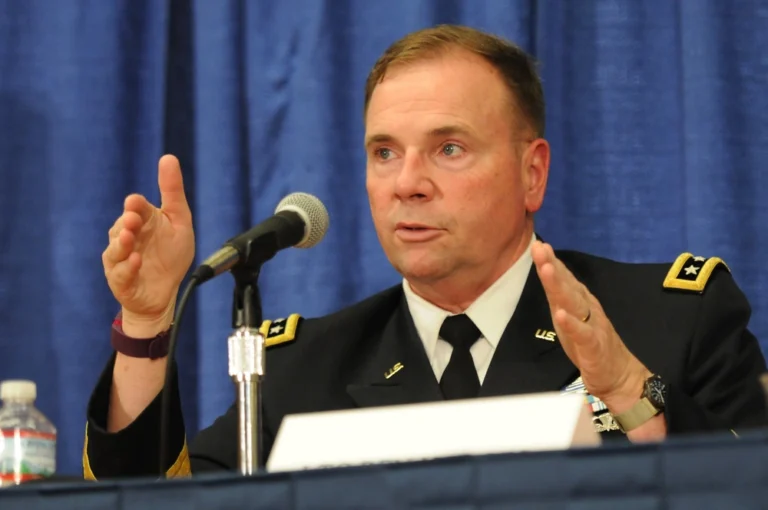
Cezary Kłosowicz, “Go Against the Tide TV” and I’m honored and pleased to welcome General Ben Hodges, former commander of US Army Europe. Good afternoon.
Good afternoon.
Thank you very much for speaking with us.
Let’s start with a very timely issue. Russian embassies in Europe are threatening with the use of nuclear weapons to defend Kaliningrad.
How do you assess these threats? Are they serious? Are they really prepared to use nuclear weapons over Kaliningrad, or is it rather testing whether the West will be intimidated? You many times said you maybe was one of the first that in case of a conflict with NATO, Kaliningrad would be neutralized within the first hours.
Does this threats change your assessment?
Well, first of all, no, it does not.
Kaliningrad, of course, is, I think, a liability for Russia.
Not so much an asset, but a liability because it is so vulnerable. It’s exposed. But it’s a place that if there was a conflict, we could not let it just sit there because of the air and sea power there, the air defense weapons there, the long-range missile capabilities there. So, it would have to be neutralized immediately. But to, I think, the real point of your question, the Russians threatening to use nuclear weapons to defend Kaliningrad, I would assume that that’s what they would say. I mean, they threaten the use of nuclear weapons all the time for everything. And I think this is a part of how they try to bully their neighbors and to scare us into inaction. Now, of course, we take it serious because they have thousands of nuclear weapons, and they don’t care how many innocent people might be killed, including their own.
But I would not confuse just the normal threats that they’re making with what would they do if there was an attack on the Russian homeland. So, that becomes more problematic, that if there was an attack on Kaliningrad, that the chance of them using a nuclear weapon of some type would go up.
But that’s why it’s so important that Russia be deterred so that they don’t make that terrible decision to attack NATO. Obviously, an attack on Kaliningrad would be in response to an attack on NATO countries. So, we have to keep this question in that context.
Still… we see more and more acts of sabotage, drone incidents, airspace violations, and other gray zone activities. We have alarms in Poland even every day, messages that say that the attacks are near the borders or even something is closing to our borders, especially here in Eastern Poland. So, we see that this threat from Russia is getting more and more serious. How should we respond? We must respond in some way, but we don’t want to respond in a way that these threats of nuclear weapons would become true.
Well, look, Russia’s gray zone operations, these things that they’re doing that are seen as below the threshold of Article 5, these are still acts of war. I mean, Russia is at war with the West, and I think the leadership in Poland has been pretty clear about that. The Poles are not confused about who the aggressor is. But it’s also important to note that if you don’t respond, if you don’t impose consequences on Russia for these gray zone operations, drones, sabotage, all the other things that they do, then they will only continue. So, you have to figure out, both nations have to figure out, but also the EU and NATO, how do you respond?
I think, obviously, shooting down drones as soon as they approach your airspace, that’s one thing, but that doesn’t really solve a problem. It’s appropriate, but it’s not the solution. I think you’ve got to look at making sure that there are no visas for any Russian anywhere in Europe. That would be something that the European Union, I think, could enforce as well as the nations. Over the 100 billion euro of Russian frozen assets that are mostly in Belgium, these should be released and used to help Ukraine pay for its modernization and its defense efforts. And Belgium has been reluctant to do this, but this is where the other nations of the EU, I think, should put their arms around Belgium and say, “We will protect you.” And there are ways to do this so that Belgium would not suffer the way that they think that they might at the hands of the Russians. These Shadow Fleet vessels, every time there’s a Russian gray zone operation in Poland, Poland should go out there and seize one of Russia’s Shadow Fleet vessels, inspect it for safety insurance, seaworthiness, environmental soundness, all the things just to really make it expensive and painful for the Russians to do this. And they go right past Poland in the Baltic Sea. So these are things, practical things, that Poland and the Union could be doing to impose consequences on Russia for their gray zone operations.
Would you say that Europe and the US is learning from these actions? Are they getting better in reaction?
Well, I would say the most positive thing is that now people are not confused about who and what Russia is. I mean, there’s at least acknowledgment. You know, the other day, Germany acknowledged it was a Russian drone that landed in Leipzig Airport. I mean, that was painful for them to finally get to that point, but they did it. So this acknowledging and putting the blame on Russia for these things is an important step. But you have to do more than just close a consulate or close a cultural center. There has to be real consequences that would cause Russia to change policy. Right now, I think the Russians don’t believe that the West has the will to really impose hard consequences. Now, some countries do better than others in different things. But I think that the connecting the dots for what Russia is doing of gray zone operations, connect that to support for Ukraine. The best way to keep Russia from ever attacking a NATO country is to help Ukraine defeat Russia. So tell the Russians, every time there’s a drone, every time there’s anything, that’s a whole another train load of ammunition or weapons or drones or other capabilities that’s going to Ukraine. So they should feel the consequences of this.
We are somewhat concerned about what the US administration is doing. On the one side, Pentagon confirmed that it’s examining the possibility of establishing a permanent military base in Poland. But on the other hand, they say that the number of US brigade combat teams in Europe has been reduced from five to three, and one of the two reduced is in Poland, the other in Romania. So, we see that the engagement of United States is getting worse as we perceive it.
Well, we don’t know what it’s going to be yet. The SACEUR, who is also the commander of US European Command, is presenting options to the Secretary of Defense for what a new force posture in Europe might look like. Some of them are okay, some of them are pretty drastic. So yes, there is a strong possibility of significant changes, whether it’s reductions or repositioning, I don’t know. It does seem like a strong likelihood that something more is coming to Poland, but that I don’t know because those decisions have not been made as far as I can tell. So, while I think it’s a mistake to reduce what we already have in Europe, I think there’s not enough and it’s a bad time for a reduction, given what Russia is doing. Nonetheless, if that’s the decision of the administration, Europe will need to be prepared to defend itself with a much, perhaps a smaller US contribution. Now, the fact is, as I think even Minister Sikorski has said, Russia cannot match the combined power and wealth and technology and capability of all of Europe. I mean, it’s not even close. The key will be European countries having the self-confidence to act together to demonstrate that they are not going to be intimidated. You’re not going to be intimidated by Russia. Right now, the Russians don’t believe that. But I think Poland plays a leading role in helping to push back on these Russian threats in the defense. Again, I think it’s a mistake, but the US may or may not be there in big numbers any longer.
So, that doesn’t make the threat go away. What raises the risk is if Ukraine fails or if Russia perceives that European countries are not working together on this.
Moving on to the Middle East, how do you assess the current situation? We see the threat of blocking the Red Sea and the bombarding of pipelines. And we don’t see any way to end this conflict between US, Israel, and Iran. Do you maybe- You see a way how it can be ended?
Actually, I don’t.
It’s very difficult to believe or to know what to believe. The president says different things every day. I mean, there really is a sort of a chaotic feel to how the Trump administration is doing this. I think that there are still negotiations going on in different ways, in different places about some way to get the strait open, about dealing with the Iranian potential nuclear capabilities. The president has told the Saudis he would not support them against the Houthis. So, as far as I can see from the outside, from a private citizen perspective,
I don’t see the cohesion of a plan. Now, it does look like the Navy is putting more and more pressure on Iran with its blockade there in the strait. So, there’s no doubt this is having enormous effect on Iran’s population. But will that be enough to cause the regime to change policy? I don’t know. The U.S. president said the other day that almost that he wasn’t in a hurry. He didn’t think this would be sorted until after the election. I don’t know. Now, the timing of all this, of course, with the U.S. election only five weeks away, it’s hard to know how much of this is real, how much of this is being used for diplomatic purposes or for negotiation purposes. I don’t know. So, the short answer is, I don’t see this ending anytime soon. I don’t see the U.S. having the ability other than economic pressure to do anything
else to Iran. And I think Iran is very, very close to… Well, today, their 45-day deadline ended about what they’re going to do about their nuclear program. So, maybe in the next day or two, we may hear something else out of Tehran about that.
How does that situation affect the global position of the United States?
Well, terrible. Number one, we have seen the limits of American military power if they’re not applied in the context of a strong strategic framework. And this administration did a terrible job of clarifying what is the objective, working with allies, understanding the enemy, and being prepared for all the contingencies. The Navy and the Air Force did a very good job on carrying out their tasks. But for it to be effective, it has to be within a broader strategic context, and I think the administration did a terrible job of that. We obviously have expended enormous amounts of munitions, and all of our enemies and potential enemies know that. The third thing, of course, the impact on energy prices affects not just the United States, but it affects most of the world. And I don’t see that change. Even if there was an end today to the war in Iran, gas prices, oil prices would not immediately come down. So, this is going to be a consequence for some time. And then finally, I think many of our allies, their trust in us has been damaged by this.
There is a debate and also the process of impeachment of Defense Secretary Pete Hegseth in context of this war against Iran. How do you assess these actions and how they impact the combat readiness of U.S. military? Is it possible that he will be changed because of this war with Iran?
Well, of course, I don’t know that. The president seems to really like Secretary Hegseth. The beginning of an impeachment process was killed immediately when the Speaker of the House, Mr. Johnson, sent the Congress home, so that could not move any further. So, we’ll see if this is tried again in the new Congress after the new year. But what’s most important to me is that the secretary has not managed this war well, as we just discussed. He has personally done things that damage relationships with our allies and damage the trust that they have. I think he has focused way too much on the culture wars about whether haircuts and beards and push-ups instead of making sure that we are properly prepared to defend all of our interests and to work with allies. He should be spending a lot more time improving relationships with our old allies and new allies instead of criticizing them so much. And also, what he’s done to the leadership of the U.S. military. I mean, it’s basic leadership. If you want to sack somebody and you have the authority, you can do it. But if you don’t tell anybody why you’re doing it, then that undermines trust in the leadership and undermines trust in the system. And so his approach to just getting rid of generals and admirals is something that I don’t think has helped us in any way. And then finally, he’s done a terrible job of working with the Congress. He goes out of his way to be disrespectful to the Congress. And without the Congress, there is no money for the Department of Defense. And I think he’s not been very clever there. Finally, I think that the lack of transparency. I mean, there’s been a question about casualties, about civilians killed as collateral damage in Iran, how many soldiers we’ve had killed or wounded, and what damage have we suffered. Nobody believes what he says anymore, and so that’s not good.
Pete Hegseth is cutting 20% of senior military positions in what is called by the media a purge of the Pentagon. That’s what the media call it, and it’s not the first.
How does that affect the military?
Well, of course, the Congress will have something to say here too. The number of people, the number of generals and admirals, all of these things are part of the law. And so, he will have to answer or should have to answer to the Senate and House Armed Services Committee. That’s number one. Number two, look, maybe there’s a case to be made that we have too many generals and admirals. That’s fine. They’re there for a reason, but let’s examine each of those positions and make a determination. But just to come in there at 20%, okay, based on what? And what capabilities or expertise are you deciding that you don’t need? And the fact is, he just never kind of lays out the thinking behind these things. And I think I’m not convinced that his approach is what’s going to make our armed forces better, protect our interests better, and help us with all of our allies and modernization efforts. I think that the Congress should be asking these kinds of questions.
Will the US midterm election really change this situation in the US and global situation?
Well, of course, it depends on the outcome. So I don’t want to make a prediction about how the midterm elections are going to-
Assuming that the Trump administration side will lose
Well, if there is a change in the House of Representatives, that will have a significant impact. And if there’s a change in the Senate, that will have a very significant impact because legislation, the president’s agenda, the budget, all of these things now would be under different leadership. So, you can imagine that there will be hearings for accountability of things done by the administration in the first two years. I think you would see the leadership stepping up to perform their constitutional oversight duties much better.
Do you think that it is possible that Trump policies will lead to proliferation of nuclear weapons?
If other nations believe they have to get their own nuclear weapons, that would be a colossal failure of American foreign policy. The United States should be that nuclear shield so that nations don’t have to go get their own weapons. This is so expensive. To have a nuclear capability is very expensive. It would take money away from other requirements, and it shouldn’t be something that other European countries, for example, or even in Asia, should have to do. So I would say that would be a failure of the administration.